Please create a highly complete "oblique perspective flat f…
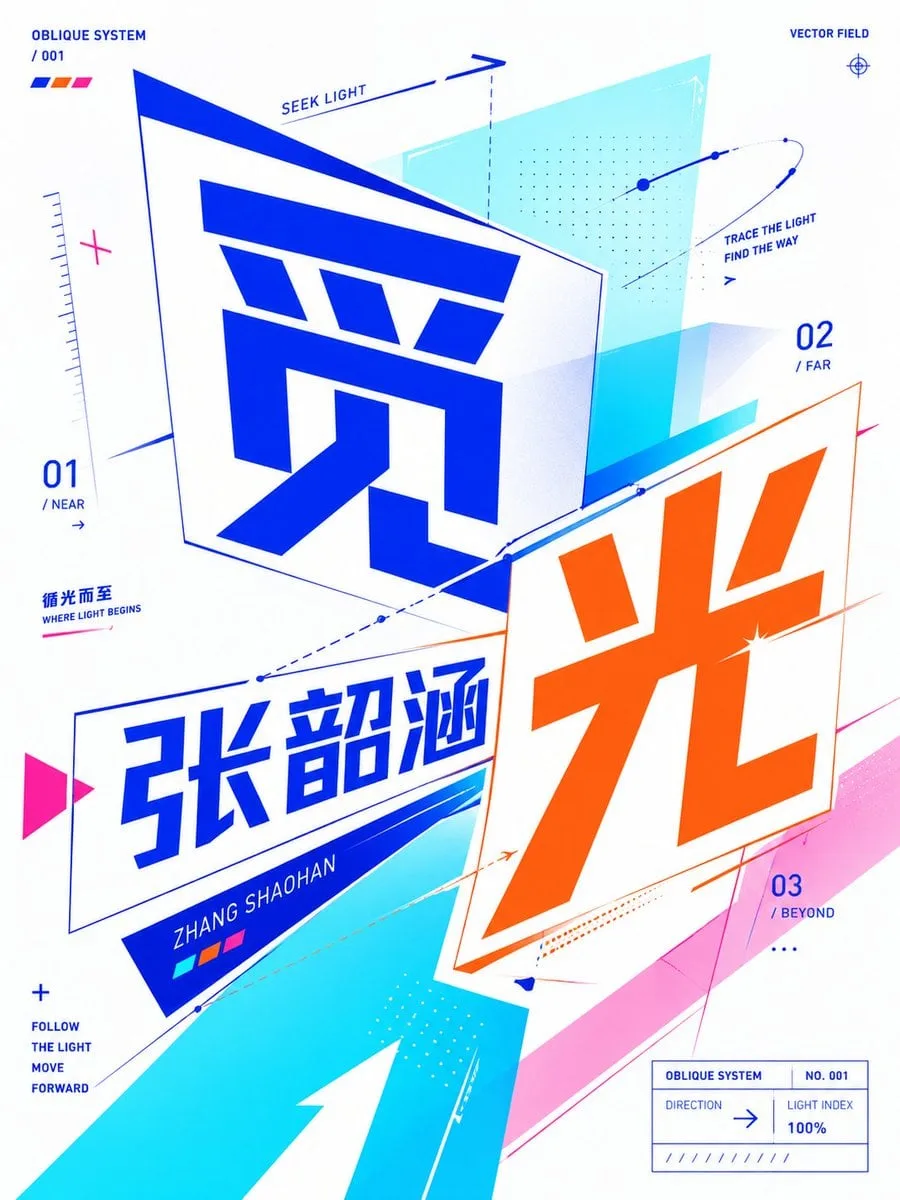
Промпт / Prompt
Please create a highly complete "Oblique Planar Perspective Typographic Poster" based on the [core text/word/phrase/short sentence/letter] input by the user. User input: [topic text]; Text language: [Chinese/English/Chinese-English mixed]; Optional supplementary context: [____]; Optional emotional tendencies: [____]; Optional disabled elements: [____]. This is not an ordinary illustration, nor is it a poster with word effects that simply enlarges the text, nor is it a traditional front-facing flat layout, but a modern experimental font poster with "text as the main visual core". The whole thing must be composed of "Oblique Planar Perspective / Oblique Planar Perspective" Typography" approach: the text should not be completely attached to the front plane, but should be placed on a two-dimensional plane with different tilt angles. Through oblique baselines, perspective compression, plane deflection, angle cutting, misalignment composition, vector pointing, directional lines, translucent geometric planes and modular color blocks, we jointly create a font composition effect that is "still a flat design, but with a clear sense of angle, spatial direction, visual tension and vector relationships". Please first truly understand the literal meaning, emotional temperament, implicit symbolism, cultural association, psychological feeling and semantic tension of the user input content, and then translate these understandings into a font poster system with "directionality, oblique relationship, plane perspective and visual confrontation/connection relationship". If the theme is more emotional, please focus on the distance relationship between the diagonal text plane, the offset of the center of gravity, the direction of the white space, the trend of the lines, the change of module density and the oppression of color blocks / Express it through release; if the theme is more action-oriented, please focus on expressing it through oblique propulsion, speed lines, direction arrows, perspective slices, misaligned planes and vector trajectories; if the theme is more relational, please focus on the angle difference, intersection and overlap between multiple text bodies, geometric planes and graphic modules. , confrontation, wrapping, cutting and intermediary structures to express; if the theme is more abstract concept, please first find a simple abstract metaphor with visual translation potential, and then use oblique perspective fonts, vector auxiliary systems, partial occlusion, hierarchical offset, module repetition and deformed grid to construct the picture. The overall picture must be presented as a modern, sharp, clear, fashionable, experimental, communicative, and visually memorable poster with high-level fonts. The text entered by the user must become the first visual subject and the core content of the entire poster. Text can be arranged horizontally, vertically, split, misplaced, grouped, reorganized, partially cropped, partially blocked, nested, tilted, perspective compressed, obliquely rotated, or even placed on two-dimensional planes at different angles, but it must always maintain high recognition and clear readability. In the picture, the audience should at least clearly feel that the text is no longer flat on the front, but has entered a planar space system composed of multiple inclined planes and directional relationships. Please focus on strengthening the following style features: the text has a sense of oblique angles, a sense of near and far plane perspective, vector relationships in different directions, inclined baselines, auxiliary arrows, geometric sections, module advancement, local frames, data-sensitive annotations, small directory-style auxiliary instructions, a small number of dot matrices and path lines. Different text or text groups can be placed in different tilted planes to form viewing angle differences, directional conflicts, visual dialogue or tension between them. Graphic elements must be built around text, not stand-alone decoration; they should support it, cut it, wrap it, extend its direction, reinforce its tilt, and work together with the text to form a complete visual sentence. In terms of visual language, please adopt the direction of modern graphic design, oblique planar perspective typography, experimental typography, bold typographic composition, flat vector aesthetics, high-contrast graphic layout, contemporary editorial poster, and crisp vector-like precision. The whole thing is not realistic, not photography, not a retro literature cover, not an old Bauhaus poster, not a heavy texture style, not a dark art poster, and not an ordinary PPT cover. It should be a visual result that is more contemporary, clearer, sharper, more digital, and more like a design company proposal or an exhibition poster. [New version color matching requirements] The color scheme must be bright, translucent, clear, gorgeous, and high-contrast, but do not use a fixed combination of blue and orange, and do not default to the common blue-orange color contrast scheme. Please automatically generate a set of bolder, more imaginative, and fresher modern high-contrast color combinations based on theme semantics, emotional temperament, and visual metaphors. It is allowed to use unconventional combinations, jumping colors, strong contrasting colors, conflicts between warm and cold, neon, digital, futuristic or artistic colors, but the overall design must still be orderly, aesthetically controlled, and have a sense of design, and cannot be chaotic and out of control. Please give priority to the color organization method of "2 main colors + 1 to 2 highlight embellishment colors + blank/structural fulcrum color". You can explore but are not limited to the following directions: fluorescent green + magenta + cool white, bright yellow + violet + black, lime green + deep purple + cyan blue, rose red + turquoise + silver white, cherry red + lake blue + pure white, mint green + bright red + dark blue, fluorescent yellow + peach + purple, coral orange + cyan + white, colorful digital splicing colors, etc. Each time you generate, please try to form an independent set of color memory points, do not repeat a single fixed main color, and do not make the series of works look like the same picture with different words. Do not use pure black for all text colors. You can use different highly saturated colors for different text subjects according to the composition, or form a primary and secondary color distribution in the same group of large characters. A small amount of dark color is allowed as a structural fulcrum, but the overall picture should be dominated by bright, clear, eye-catching, and avant-garde color impressions. Color should serve semantic expression, not just for fun; it should make the audience feel that the color is "designed" rather than randomly piled up. The composition should be bold, slanted, with a sense of propulsion and direction, but at the same time control the order of the picture. It is recommended to use 1 set of core title bodies, 1 set of oblique perspective text plane system, 1 set of geometric vector and color block structures, a small amount of auxiliary annotation information and dotted line symbols. The image needs to retain enough white space to allow the highly saturated colors and slanted text to breathe and feel like an exhibition poster. You can add a small amount of small font descriptions, labels, numbers, English keywords, minimalist subtitles or short sentences to strengthen the concept, but you must exercise restraint and do not steal the visual weight of the main title. Auxiliary information can simulate the annotation language in a visual identity system or editorial design, such as short words, parameters, indexes, directional instructions, concept tags, etc. Fonts and typography must be modern, clear, eye-catching, powerful, and somewhat experimental. For Chinese, it is suitable to use geometric sans serifs, titles with a strong sense of modern design, narrow and long fonts, or fonts with a faceted feel; for English, it is suitable to use bold grotesk, condensed sans, geometric sans, editorial sans, etc. Local stretching, compression, beveling, perspective distortion, and slice misalignment are allowed, but do not make the text into real 3D extruded words, no heavy projection, no real three-dimensional modeling, no metal words, no glass words, and no relief words. The focus is on the "sense of space in a plane" rather than the "sense of physical three-dimensionality". Graphic elements can be used: oblique rectangles, oblique plane boxes, triangular chamfers, dot systems, arrows, path lines, thin line auxiliary grids, perspective borders, direction vectors, dot matrix modules, data-sensitive short lines, color block patches, translucent geometric slices, local circular lines, partition labels, small-size index information, etc. These elements must serve the theme semantics and font composition and should not be reduced to pure decoration. Please avoid the following issues: Do not make an ordinary front-facing poster with tiled fonts, do not make a traditional minimalist typography cover, do not make a realistic photography or illustration, do not make a heavy 3D text, do not make a retro low-saturated or beige-tone poster, do not pile up irrelevant graphics, do not over-decorate, do not make the text unreadable, do not make the picture dirty and crowded, do not let the graphics be disconnected from the theme words, and do not default to the same main color scheme repeatedly. If appropriate, please automatically generate a very short subtitle or conceptual sentence to help explain the topic, such as "Between ____ and ____", "The tension of ____", "A state of ____", "Where ____ begins", or generate a more concise Chinese sentence based on the Chinese context, but it must be kept short, restrained, and designed. The final output should be a modern font concept poster that is highly complete, modern, bright, high-contrast, flat, sharp, highly experimental, has a sense of diagonal perspective font composition, is readable and has a sense of design, and is more bold and free in color matching, more imaginative, and does not fall into the fixed blue and orange routine.
Модель / Model: GPT Image
Тип / Type: фото / photo
Автор / Author: Kurator
Категории / Categories: Реклама и товары
Теги / Tags: журнальный, 3D, постер
Похожие промпты / Related
- Main Subject:
- Main Subject
- Create a 16:9 monochrome storyboard line-sketch sheet for...
- Ultra-realistic commercial food photography of a Lay's po...
- 15-second 2D animated video.
- "Create an ultra-premium cinematic commercial featuring a...
- Ultra-realistic premium food commercial. Static camera. P...
- Create a 15-second photorealistic Korean shampoo commerci...
- Create a cinematic luxury fashion advertisement video usi...
- Create a 9-second cute watercolor-style animation on a cl...
- SEEDANCE 2.0 — LIVE-ACTION AIRPLANE CRASH
- Character: A beautiful young woman with voluminous curly ...