IMAGE FORMAT:Create a horizontal 3:2 landscape image. Use...
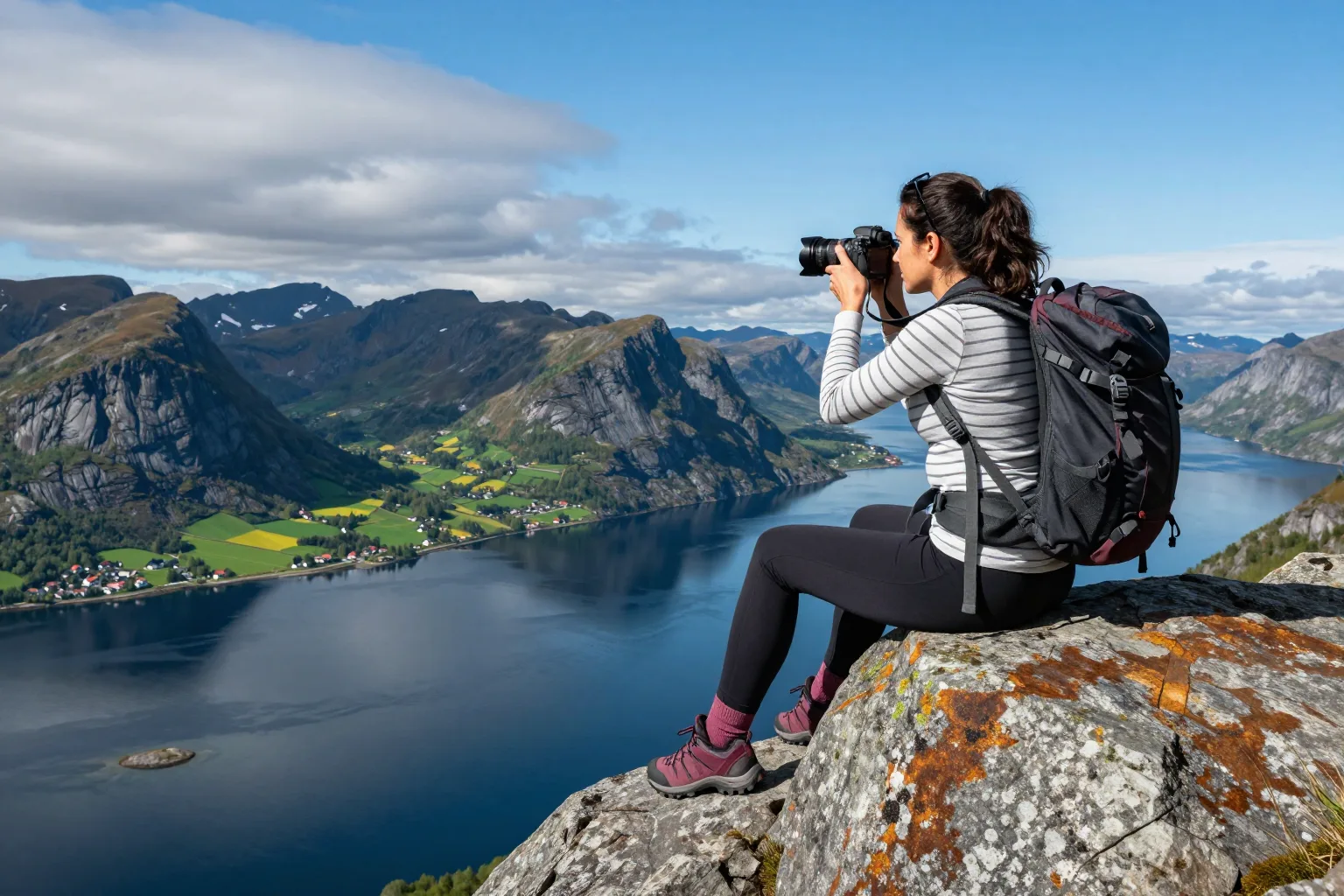
Промпт / Prompt
IMAGE FORMAT:Create a horizontal 3:2 landscape image. Use a wide environmental composition with a large sky, an expansive lake or fjord, vivid green farmland, layered rounded mountains and a prominent foreground rock ledge. The image should resemble professional Scandinavian adventure photography or a polished northern European tourism campaign.PRIMARY COMPOSITION:Place one adult female traveler on a large rocky ledge in the right third of the image. The landscape must open broadly toward the left. Position the distant horizon slightly below the vertical center of the frame. Let the sky occupy approximately the upper 35 to 40 percent of the image.The foreground rock should enter from the lower-right corner and project toward the center. The traveler should sit near its outer edge, creating a strong visual contrast between the close human subject and the vast landscape beyond.Keep the traveler large enough for her pose, clothing, camera and backpack to be clearly visible, but do not let her dominate more than approximately the right third of the image.TRAVELER ORIENTATION:Show the traveler from a three-quarter rear and side angle. Her back should face partly toward the viewer while her upper body and face turn toward the left-hand landscape. Do not show a clear frontal face. Her face should be largely obscured by the camera and her profile orientation.She must be actively photographing the landscape through the camera’s viewfinder. Her gaze and camera lens should point toward the left-center mountains and water.POSE:Seat the traveler naturally on the top surface of the rock ledge.Raise the leg closest to her torso, bending the knee sharply toward her chest. Rest that foot securely on the upper rock surface close to the ledge.Extend the other leg downward over the front of the rock, allowing it to hang freely toward the lower-center area of the frame. The dangling leg should create a clear diagonal line.Keep her torso upright but leaning very slightly forward as she concentrates on taking the photograph.Raise both hands to the camera at eye level. One hand should grip the camera body near the shutter button, while the other hand supports or adjusts the lens.Keep both elbows naturally bent. The camera must sit directly in front of her eye rather than being held away from her face.Ensure anatomically accurate body proportions, correctly connected limbs, natural joints and exactly two arms, two hands, two legs and two feet.HAIR AND HEAD:Give the traveler thick dark-brown or black hair tied into a medium-height or high ponytail. Include a few loose strands affected subtly by the breeze. Add realistic daylight highlights to the hair.Optionally place a pair of dark sunglasses securely on top of her head, partially integrated into the hairstyle. Do not place sunglasses over her eyes because she is looking through the camera viewfinder.CLOTHING:Dress the traveler in a fitted long-sleeved casual outdoor shirt with narrow horizontal stripes. Use a white or light-gray base with closely spaced dark-gray or black lines. Make the fabric soft and slightly stretched around the bent arms and torso.Give her fitted black or dark-charcoal hiking leggings or outdoor trousers. The trousers should be slightly cropped above the ankles.Add visible burgundy, dusty-pink or muted-magenta hiking socks.Give her lightweight plum, burgundy or dusty-purple trail shoes with pale midsoles, dark tread and light-colored laces. The shoes must be properly aligned with the feet and rendered with realistic construction.Avoid brand logos, readable labels or recognizable commercial markings.CAMERA:Place a compact black mirrorless or DSLR camera at the traveler’s eye.Use a short to medium-size photographic lens suitable for landscape photography. Show her left hand supporting the lens and her right hand holding the camera grip.Add a dark camera strap hanging naturally from the body or passing around her neck. The strap must not merge with her arms, clothing or backpack straps.The camera should look functional and physically plausible, with a visible lens barrel, grip and viewfinder, but no readable brand name.BACKPACK:Attach or position a large dark hiking backpack behind the traveler. It should rest naturally against her back and partly on the rock.Use black, charcoal or very dark burgundy fabric with restrained red or burgundy piping. Include:- Padded shoulder straps- Several zippered compartments- Small attachment loops- Compression straps- Realistic fabric folds- Subtle zipper pulls- A moderately full but not oversized profileLet the backpack rise close to shoulder or lower-head height. It should feel suitable for a full-day hike rather than a multiday mountaineering expedition.Keep the backpack visually separate from the traveler’s body, ponytail and camera strap. Do not merge the straps or produce impossible overlaps.FOREGROUND ROCK:Create a broad weathered rock outcrop projecting over the landscape from the lower-right corner.Give its top a mostly horizontal but irregular surface large enough for the traveler to sit safely. The ledge should appear elevated and dramatic without looking physically impossible.Use highly detailed gray, brown, warm ochre and muted-rust stone textures. Add:- Coarse mineral grain- Small fractures- Dark crevices- Uneven edges- Pale lichen patches- Weathered indentations- Rough upper surfaces- A darker vertical face beneath the ledgeCrop the lower portion of the rock naturally at the bottom and right edges of the image.Do not make the rock smooth, geometric, artificial or uniformly colored.WATER:Fill much of the lower-left and central landscape with a broad calm lake or fjord.Use deep navy-blue and rich cobalt water in the foreground, becoming lighter and more blue-gray toward the distance.Create a mostly smooth reflective surface with subtle natural ripples. Reflect portions of:- The blue sky- White clouds- Dark mountain slopes- Green shorelinesInclude a large soft cloud reflection in the lower-middle water.Add a very small natural rocky islet in the lower-left quadrant. Give it a brown-gray rocky center and a thin fringe of low green vegetation.Do not add boats, swimmers, docks or artificial structures on the water.FARMLAND AND SHORELINE:Across the middle-left region, create a vivid patchwork of green agricultural fields extending along irregular peninsulas and shorelines.Include:- Bright spring-green grass fields- Yellow-green meadows- Darker cultivated parcels- Tree-lined boundaries- Small groves- Hedgerows- Narrow rural roads- Curving shorelines- Low forest stripsArrange the fields as irregular organic parcels rather than a rigid grid.Add a small number of distant farmhouses and rural buildings. Use tiny white, cream or muted-red walls with red or orange roofs. Keep the buildings small and naturally integrated into the terrain.Do not allow the settlement to become a town or city. There should be no high-rise buildings, industrial structures, highways or dense urban development.MOUNTAINS:Surround the lake with layered rounded mountains and hills.On the far left, place a wide dark-green mountain descending directly toward the water. Give it a rounded summit, vegetated slopes and subtle shadowing.Across the center, create multiple overlapping hills and mountains with:- Rounded and gently irregular summits- Green lower slopes- Olive and brown upper areas- Exposed gray rock faces- Small saddles- Broad valleys- Subtle cloud shadowsCreate a narrowing corridor of water between the central mountains so the lake appears to recede far into the distance.Render the farthest mountains in softened blue-gray and muted mauve tones to create atmospheric depth.On the far right, include part of another green-brown mountain slope behind the traveler and backpack. Use it to close the right edge of the composition without obscuring the subject.The mountains should resemble believable northern European coastal or fjord geology. Avoid sharp Himalayan peaks, desert mesas, tropical cliffs or fantasy formations.SKY:Create a broad, highly detailed blue sky occupying the upper portion of the frame.Use:- Rich cobalt blue toward the upper-right- Clear cyan-blue across the center- Paler blue toward the left horizonAdd a large layered white and pale-gray cloud bank across the upper-left quadrant. Give it soft stratified forms, gray-blue undersides and brighter sunlit upper surfaces.Place a small elongated white cloud near the upper-center.Across the upper-right, include thinner wind-stretched clouds with feathered, semi-transparent edges.The sky should feel expansive, clear and changeable but not stormy.Do not include rain, lightning, heavy black clouds, stars, sunset colors, birds or aircraft.LIGHTING:Use strong natural daylight coming primarily from the upper-left or front-left.Illuminate:- The traveler’s striped sleeves- The top of her ponytail- Her shoulders- The raised knee- The upper rock surface- The bright fields- Selected mountain slopesCreate deeper shadows:- Beneath the rock ledge- Within the backpack folds- Behind the traveler’s limbs- On shaded mountain faces- In the deepest waterKeep the traveler fully readable rather than silhouetted.Retain detail in both the bright clouds and the darkest water. Use a controlled high-dynamic-range exposure without blown highlights or crushed shadows.COLOR PALETTE:Use a vivid but believable travel-photography palette dominated by:- Cobalt and cyan-blue sky- Deep navy and blue-gray water- Bright yellow-green fields- Dark forest green tree lines- Olive and brown mountains- Warm gray, ochre and rust rock- Plum, burgundy and dusty-pink footwear- Black and charcoal hiking equipment- White and pale-gray cloudsThe green fields and blue water should appear vibrant and inviting, but avoid fluorescent or artificial neon colors.PHOTOGRAPHIC STYLE:Render the result as high-end, photorealistic outdoor travel photography.Use the visual equivalent of:- A professional full-frame camera- A 24–30 mm wide-angle lens- Aperture around f/8 to f/11- Low ISO- Crisp daylight exposure- Deep depth of field- Sharp foreground subject- Clearly resolved farmland and middle-distance mountains- Mild atmospheric softness in the farthest terrainMaintain realistic perspective without fisheye distortion. The traveler and rock should be crisp, while distant mountains should become progressively softer and less contrasty.POST-PROCESSING:Apply a polished commercial-travel finish with:- Moderate dehaze- Strong but controlled clarity- Enhanced local contrast- Recovered shadow detail- Protected cloud highlights- Rich blue and green saturation- Fine natural sharpening- Clean low-noise texture- Subtle atmospheric perspectiveAvoid excessive HDR halos, oversharpened edges, unnatural glow or plastic-looking surfaces.MOOD:The final image should communicate peaceful adventure, personal exploration, creative focus and the pleasure of discovering a vast natural landscape. It should feel aspirational, calm, vivid and authentic rather than dangerous, theatrical or staged.STRICT CONSTRAINTS:Exactly one person.One adult female traveler only.Three-quarter rear or side view.No clearly visible frontal face.Traveler must be actively looking through the camera viewfinder.Exactly two arms, two hands, two legs and two feet.No duplicated limbs or fingers.No malformed hands.No floating camera.No merged camera and face.No merged backpack and body.No additional hikers.No animals.No vehicles.No boats.No city skyline.No large resort.No tropical vegetation.No snow-covered mountains.No dramatic cliff collapse.No waterfall.No sunset.No fog obscuring the landscape.No shallow depth of field.No blurred traveler.No fisheye curvature.No illustration, painting, anime or obvious CGI.No readable text.No brand logos.No watermark, border, caption or signature.
Модель / Model: Z Image
Тип / Type: фото / photo
Автор / Author: DexterJani
Категории / Categories: Реклама и товары, Портреты и люди, Арт и иллюстрация, Лайфстайл
Теги / Tags: люкс, аниме, иллюстрация, реклама, 3D, обложка, логотип, реализм
Похожие промпты / Related
- Create a professional cinematic commercial storyboard in ...
- Ultra-detailed 16:9 oriental fantasy character design she...
- Cinematic 15 second commercial fashion promo shot on 35mm...
- Extreme close-up macro cinematography.
- Create a premium cinematic character bible sheet for a ma...
- A realistic handheld travel vlog filmed by a friend follo...
- Create a premium, ultra-photorealistic 15-second commerci...
- Spider-Man:
- Create a 30-second ultra-realistic candid home-video sequ...
- L’ORÉAL — “NOT A STRAND”
- Setting: A cozy indoor room with warm, ambient lighting, ...
- Premium fashion editorial.