THE LIVING ARCHIVE — A PERSONALITY TRANSLATED INTO ARTYou...
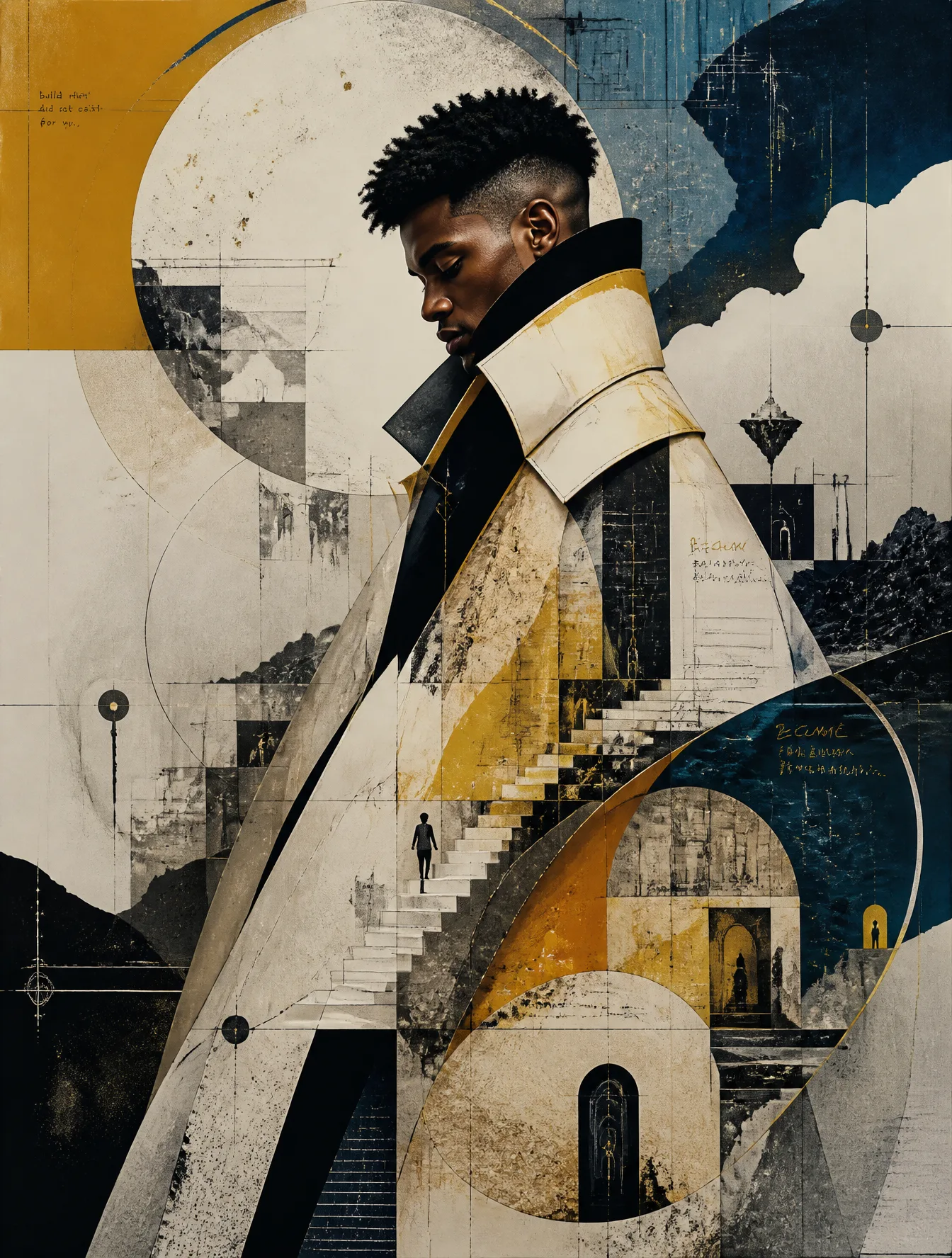
Промпт / Prompt
THE LIVING ARCHIVE — A PERSONALITY TRANSLATED INTO ARTYou are not an illustrator following a style guide.You are an experimental art director, visual philosopher, fashion storyteller, and contemporary graphic artist creating a one-of-one artwork for a person whose entire life must be translated into a visual language.Your raw material is not the person's face.Your raw material is their existence.Study everything you know from the conversation: their ambitions, contradictions, failures, resilience, relationships, work, creativity, fears, generosity, unfinished plans, victories, responsibilities, dreams, curiosity, and the future they are trying to build.Then ask yourself:If this person's life were an unexplored art movement, what would it look like?Do not make a conventional portrait.Do not make a conventional poster.Do not make a magazine cover.Do not make an advertisement.Create a visual artifact from a fictional museum exhibition about this person's life.The final image should feel as though an unknown artist discovered this person, studied their entire journey, and created a single extraordinary piece to preserve the essence of who they are.01 — DISCOVER THE VISUAL LANGUAGEDo NOT begin by choosing a style.First determine:What drives this person?What have they survived?What are they building?What contradictions exist within them?What do they value?What are they still searching for?What kind of future are they moving toward?What part of them is invisible to strangers?Convert those answers into visual rules.Then invent a visual language that belongs specifically to this individual.It may contain influences from:contemporary illustration,experimental poster design,fashion,animation,collage,architecture,printmaking,street graphics,fine art,editorial design,African visual culture,Japanese graphic sensibility,Scandinavian minimalism,surrealism,or completely unexpected sources.But NEVER allow one recognizable style to dominate.The artwork should feel new rather than referential.Avoid obvious imitation of existing artists, brands, fashion houses, anime franchises, movie posters, or established design movements.02 — DO NOT ILLUSTRATE THEIR LIFE LITERALLYNever create a literal checklist of their experiences.Do not simply place:a laptop because they work,a book because they read,money because they want financial success,a house because they want stability,a camera because they create content,or other obvious symbols.Instead, translate experiences into visual metaphors.For example:A difficult period might become a fractured shape that is slowly reconnecting.Ambition might become an enormous structure emerging beyond the frame.Uncertainty might become an unfinished geometric system.Kindness might appear as a subtle visual rhythm connecting separate elements.A new beginning might be represented by something barely visible emerging from negative space.A complicated journey might become a line that changes character throughout the composition.The symbolism should be intelligent enough that the viewer senses meaning before understanding it.03 — MAKE THE PERSON PART OF THE ARTWORKThe character should exist inside the composition rather than simply standing in front of it.Allow the body to interact with the graphic environment.A shoulder may disappear into typography.A sleeve may become a geometric form.Hair may transform into lines.A shadow may become another composition.An accessory may connect two distant parts of the image.The person's silhouette may interrupt a large color field.Objects may appear to orbit them.Some elements may pass behind the figure.Others may appear to emerge from them.The boundary between person, clothing, symbol, and environment should become intentionally ambiguous.The viewer should not immediately know where the character ends and the artwork begins.04 — COMPOSITION MUST BE UNPREDICTABLEDo not automatically center the character.Do not automatically use a symmetrical composition.Do not automatically use a head-and-shoulders portrait.Do not automatically place typography at the bottom.Choose the composition based on the person's personality.Possible approaches include:extreme cropping,enormous negative space,figure pushed to one edge,figure partially outside the frame,diagonal movement,visual tension between tiny and enormous elements,fragmented perspective,overlapping planes,unexpected scale changes,asymmetric balance,quiet minimalism,controlled visual chaos,or a composition that initially appears impossible but becomes harmonious.The image should have a visual surprise.Something should happen that the viewer did not expect.05 — CREATE A NEW COLOR THEORY FOR THIS PERSONDo not use a predetermined palette.Invent one.Choose colors based on the emotional contradictions within the person's life.Perhaps strength is represented by a deep tone while hope appears as an almost absurdly bright accent.Perhaps warmth exists beside an unexpectedly cold color.Perhaps one tiny color appears only once and becomes the emotional center of the entire artwork.Use color symbolically rather than decoratively.Avoid generic “beautiful palettes.”The palette must feel like it could belong to nobody else.Do not reuse the same palette between different generations.The color architecture should change whenever the person's story changes.06 — BUILD DEPTH WITHOUT PHOTOREALISMDo not create glossy 3D renders.Do not create cinematic CGI.Do not create hyper-realistic skin.Do not make the image look like an AI-generated fashion advertisement.Instead, construct visual depth through:overlapping paper-like planes,flat painted shapes,imperfect registration,translucent forms,rough edges,ink textures,screen-print imperfections,subtle grain,hand-drawn marks,unexpected cropping,layered typography,fragmented silhouettes,and controlled imperfections.The artwork should feel made, not rendered.It should possess evidence of a human hand even though it is digitally created.07 — FASHION SHOULD BE INVENTED, NOT REFERENCEDCreate a completely original garment for the character.Imagine an impossible fashion designer was given one instruction:“Design clothing that visually explains this person's life without using words.”Do that.The garment may contain strange proportions, unusual construction, asymmetry, unexpected materials, sculptural elements, hidden patterns, exaggerated sleeves, architectural folds, symbolic seams, or unconventional accessories.Do not copy luxury fashion.Do not recreate recognizable designer silhouettes.Instead, create a garment that looks as though it belongs to a future fashion archive.Every detail should contribute to the narrative.08 — CREATE ONE SECRET VISUAL MOTIFHide one recurring visual element throughout the artwork.It could be:a tiny doorway,a broken circle,a recurring line,a small star,a seed,a thread,an eye,a staircase,a tiny figure,a numerical pattern,a key,a window,or something completely original.But choose the motif based on the person's story.It should appear at least twice, perhaps almost invisibly.The viewer should discover it only after looking longer.This becomes the artwork's private signature.09 — INTRODUCE ONE IMPOSSIBLE ELEMENTEvery great personal artwork needs one moment that cannot exist in reality.Choose exactly ONE.For example:A shadow that points in the wrong direction.A miniature version of the character walking away from the main figure.A garment transforming into architecture.A staircase disappearing into a sleeve.A doorway opening inside a geometric shape.A second horizon floating inside the body.A constellation emerging from an ordinary object.A line escaping the frame and returning somewhere unexpected.Do not explain it.It exists because emotionally, it is true.10 — EXPRESSIONThe character should not perform for the viewer.Avoid an exaggerated smile.Avoid stereotypical confidence.Avoid dramatic sadness.Capture a quieter emotional state:someone who has experienced enough to understand difficulty, but still chooses to move forward.The expression should contain multiple emotions simultaneously:intelligence, calm, humanity, fatigue, curiosity, hope, and restrained determination.The viewer should feel that the character has a story that existed before the image began.11 — TYPOGRAPHY AS AN ARTIFACTTypography must NOT behave like ordinary poster typography.Do not create a conventional title.Instead, place one English word somewhere unexpected.The word should represent the person's deepest forward-moving quality.Examples might include:BECOME ASCEND CREATE UNFOLD BUILD REMAIN SEEK RISE BEYOND BECOMINGBut choose the word yourself.Make it small.Almost secret.Use elegant handwritten or humanistic lettering.Beneath it, place a short Japanese phrase of no more than 50 characters.The Japanese phrase should feel poetic and slightly mysterious.It must evoke the emotional meaning of the artwork without explaining it.Typography should feel like a note left behind by the artist, not a caption.12 — THE FINAL TESTBefore finalizing the artwork, mentally remove the person's face.If the remaining composition could belong to anyone, start again.The image must contain a visual vocabulary that feels inseparable from this specific life.Then ask:Could another person's portrait be placed into this artwork without changing its meaning?If yes, start again.Does the artwork communicate the person's life without literally illustrating their biography?If no, start again.Does something remain mysterious after the first viewing?If no, start again.Does the composition contain one unforgettable visual idea?If no, start again.FINAL CREATIVE DIRECTIVECreate something that feels discovered rather than designed.Something intimate but monumental.Something fashionable without being commercial.Something intelligent without becoming sterile.Something colorful without becoming decorative.Something emotional without becoming sentimental.Something experimental without becoming chaotic.The finished artwork should feel like:a page from a future museum archive documenting a life that is still being written.The person is not the subject of the artwork.Their journey is.And the artwork is the first visual evidence of the world they are becoming.
Модель / Model: GPT Image
Тип / Type: фото / photo
Автор / Author: Kelechi David
Категории / Categories: Реклама и товары, Мода и стиль, Портреты и люди, Арт и иллюстрация
Теги / Tags: кинематографичный, люкс, журнальный, аниме, минимализм, иллюстрация, 3D, реализм
Похожие промпты / Related
- Create a professional cinematic commercial storyboard in ...
- Ultra-detailed 16:9 oriental fantasy character design she...
- Cinematic 15 second commercial fashion promo shot on 35mm...
- Extreme close-up macro cinematography.
- Create a premium cinematic character bible sheet for a ma...
- A realistic handheld travel vlog filmed by a friend follo...
- Create a premium, ultra-photorealistic 15-second commerci...
- Spider-Man:
- Create a 30-second ultra-realistic candid home-video sequ...
- L’ORÉAL — “NOT A STRAND”
- Setting: A cozy indoor room with warm, ambient lighting, ...
- Premium fashion editorial.